Echoes of War
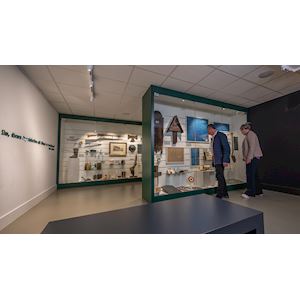
Many traces of war can still be found in the landscape today. Among the most important witnesses to wartime suffering are the cemeteries. Some were laid out during the war, but many men were given a temporary burial on the battlefield. Those field burials were often destroyed by later fighting. After the war, specially established units went in search of the war dead in the devastated landscape. To the right, in the first display case, you’ll see a gun cleaning rod, an instrument often used to probe the ground. The bodies they found were reburied in large war cemeteries. On both the Allied and the German side, war graves organizations were set up, which often still maintain the cemeteries to this day. Eventually many cemeteries were combined. The Germans, French and Belgians allowed reburial in the home nation, while the British opted not to repatriate their dead. As well as the eye-catching cemeteries, less conspicuous places too are part of the memorial landscape. In the surroundings of Zonnebeke and Passchendaele, a soldier will have died in every field, on every corner and in every patch of woodland. This gives everyday places great emotional value. Finally, there are many relics of war such as bunkers, craters and archaeological remains, and they all have an important story to tell. On the interactive map in this room you can explore the locations of thousands of field burials and other important commemorative sites.

Passchendaele Museum
Discover what our museum has to offer by listening to or by reading the audio stops below.
- Berten Pilstraat 5A
- Zonnebeke Belgium
- 0032 (0)51 77 04 41
- www.passchendaele.be