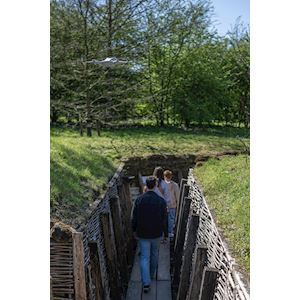
German trenches
Trenches are symbolic of the First World War, but they had been used for centuries before. They provide protection during sieges, and enable soldiers to approach the enemy without being noticed. Here you can walk through reconstructions of both German and British trenches. We begin our walk in a German fighting trench, recognizable by the platforms from which the men could shoot over the breastwork. The higher parados ensured that their silhouettes could not be seen from a distance. Trenches often ran across the landscape in a zigzag pattern, to reduce the effect of shelling. In case of a direct hit, the force of the explosion would not travel in a straight line but be limited to that corner of the trench. The high groundwater level and impermeable clay made it impossible to dig deep. To prevent the men having to move through the trenches bent double, the soil they removed was collected in sandbags, which served as parapets front and back and provided some protection against bullets and shell fragments. Try looking through the embrasures. Can you see that it’s almost impossible to observe the battlefield in safety? Enemy snipers continually kept an eye on these openings. Because of a shortage of building materials, the German trenches became simpler over time. Now walk on until you reach British lines.

Passchendaele Museum
Discover what our museum has to offer by listening to or by reading the audio stops below.
- Berten Pilstraat 5A
- Zonnebeke Belgium
- 0032 (0)51 77 04 41
- www.passchendaele.be