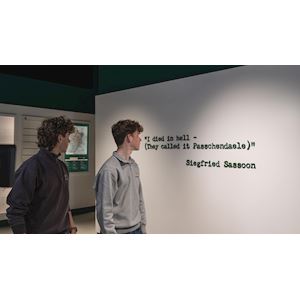
We died in Hell
Death continually lurked round the corner. Hundreds of thousands of men were wounded during the Battle of Passchendaele. Those who could still walk made their way back behind the lines under their own steam, while others were carried on stretches. At the centre you can see a British stretcher, dating from 1917. The wounded received first aid at a dressing station at the front. For further treatment they were taken to a field hospital and later evacuated to hospitals back behind the lines or to their home countries. Medical logistics were a huge task. On the opening day of the Battle of Passchendaele the British field hospital in Poperinge treated more than 13,000 casualties in just 24 hours. They included not just the wounded but victims of the devastating effects of bad weather, hunger, thirst and inadequate hygiene, which exhausted the men both physically and mentally. Many soldiers suffered from ailments such as trench foot, flu and diarrhoea. The use of antibiotics to treat infected wounds was still at an early stage, so bacterial infections were a major cause of death. As well as inflicting physical ordeals, the war took a heavy mental toll. In 1917 fear was given a new face. Psychiatric problems often became an ‘invisible’ enemy. The mud, death and destruction were indelibly printed on the memories of many former servicemen. Animals too suffered terribly at the front. In this room you can see a medicine chest that belonged to a German horse doctor. Take a good look at the various medicines. They include cocaine, which as well as being an anaesthetic was used to drive exhausted horses to the limits of their strength.

Passchendaele Museum
Discover what our museum has to offer by listening to or by reading the audio stops below.
- Berten Pilstraat 5A
- Zonnebeke Belgium
- 0032 (0)51 77 04 41
- www.passchendaele.be