Landscape at war
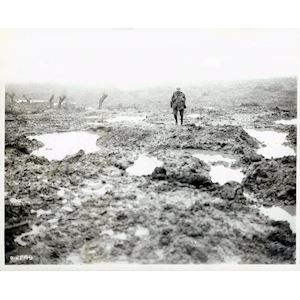
In 1917 the green surroundings of Passchendaele were transformed into a muddy moonscape. Everything became difficult: orientation, transport and communications. Conditions were tough. Shelled streams, which in wet Flanders served as part of the drainage system, and underestimated German defences slowed the advance. Weapons became blocked by mud and filth, so that striking and thrusting weapons came back into use. Look too at the waders and ponchos, essential protection against the mud and the wet weather. The men were given specialist tasks. Some threw hand grenades, while others manned light machine guns. In 1917 brand new tanks were deployed to break through German barbed-wire emplacements and fortified positions. But even the tanks struggled on the difficult terrain and often became stuck in the mud, making them an easy target for German artillery. Look at the tank fragment in the middle of the room; excavated in Zonnebeke, it’s the front of a British Mark IV tank with viewing slits for the driver. Weather conditions were clearly anything but ideal for a decisive offensive. See the big cross section of the landscape? It shows how the Allies advanced gradually, in three phases. The French, British, Australians and New Zealanders initially attacked on a broad front. But German counterattacks forced them back and in mid-August they had still not reached the objectives of the first day. In September the offensive resumed in better weather. New Zealanders, Australians and South Africans replaced the British in the spearhead of the attack. They slowly gained ground, with enormous losses. In mid-October the artillery, reinforcements and supplies became stuck in the mud when the rain started again. Lacking sufficient artillery support, further attacks failed. Yet the British high command persisted. Eventually the Canadians succeeded in taking the high ground around Passchendaele. But harsh winter weather made further operations impossible.

Passchendaele Museum
Discover what our museum has to offer by listening to or by reading the audio stops below.
- Berten Pilstraat 5A
- Zonnebeke Belgium
- 0032 (0)51 77 04 41
- www.passchendaele.be