Artillery
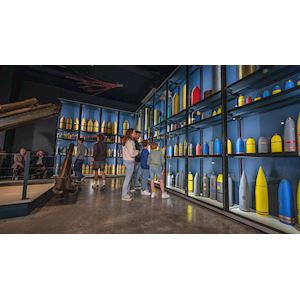
Welcome to the artillery room. The German 15 cm heavy field howitzer with its limber will draw your attention immediately. This heavyweight was capable of a range of up to eight kilometres. Take a look too at the collection of colourful munitions. The different colours helped the men to quickly identify each shell. Artillery had a crucial part to play in the Battle of Passchendaele. Massive preparatory bombardments did not succeed in destroying all German positions. The shelling did destroy the landscape, however, including the drainage systems. When it rained, which happens rather a lot in Flanders, the water on lower-lying areas was unable to drain away properly. This made it difficult to move the guns forward, resulting in inadequate artillery support and failed attacks. Millions of shells were fired during the battle. In the muddy fields of Flanders more than a fifth of munitions failed to detonate. To this day the Belgian army’s ordnance disposal service removes hundreds of tonnes of unexploded munitions every year. Before you leave the room, look up for a moment. Can you see the big painting? It’s an artwork on loan from the Australian War Memorial. It shows Australian troops during the battle of Polygon Wood.

Passchendaele Museum
Discover what our museum has to offer by listening to or by reading the audio stops below.
- Berten Pilstraat 5A
- Zonnebeke Belgium
- 0032 (0)51 77 04 41
- www.passchendaele.be