Building at the front
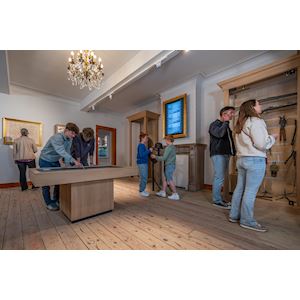
In 1916 the Germans were shaken awake. Whereas in the east they had pulled out all the stops and attacked Russia, in the west they opted for defence in depth, with a series of relatively sparsely manned defensive lines. They made optimal use of the terrain and connected up the most strategic landscape elements. In this room you can see the various materials that were used in improving those defensive lines, such as a builder’s setsquare or a pair of wire-cutters. For this hard and frequently dangerous work the German high command often deployed local men from occupied Belgium and France. Several post cards in the display case show these civilian workers in the service of the German army. In 1916 and 1917 five German defensive lines were laid in Flanders, the Albrecht-, Wilhelm, Flandern I, II and III-Stellungen. In between them the Germans built bunkers and strongholds that functioned as breakwaters. In the case of an attack, some units would be blocked while others advanced. This broke up the wave of attack into smaller, isolated groups. Behind the front, German troops stood ready to force the scattered enemy back with targeted counterattacks. Despite this, The British high command was hoping for a breakthrough in 1917.

Passchendaele Museum
Discover what our museum has to offer by listening to or by reading the audio stops below.
- Berten Pilstraat 5A
- Zonnebeke Belgium
- 0032 (0)51 77 04 41
- www.passchendaele.be