William Morris & Merton Industries
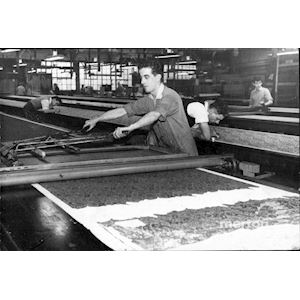
Meet William Morris – poet, painter, textile designer, socialist and activist – but first and foremost a practical working artist. He is famous for his belief that you should “Have nothing in your house you do not know to be useful or believe to be beautiful.” His firm, Morris & Co, made hand-crafted, high quality goods including furniture, textiles, tapestries, wallpaper and stained glass – all from its workshops at Merton Abbey. Most were destined for private homes, but he also produced work for museums, royal palaces and churches. Here, we look at designs and products created by Morris & Co at the Merton Abbey works and the craftsmen and designers involved. Although William Morris himself died at the age of 62 in 1896, the firm that he founded continued, under the direction of his former apprentice John Henry Dearle, until the second world war. After moving his printing works to Merton in 1881, William Morris perfected his indigo dyeing technique – the six foot deep indigo vats can be seen in old photographs of the works. Many of Morris’ best known designs – including the examples shown here of Strawberry Thief, Wandle and Windrush – used this technique. Although originally designed for printed cotton, the designs are still used today to decorate everyday household items. The painter Edward Burne-Jones was a lifelong friend and collaborator of William Morris. His designs for stained glass windows produced by Morris & Co can be found both here in Merton – at St Mary’s church in Merton Park – and around the country. William de Morgan, the artist and ceramicist, was another close collaborator – his works occupied part of the Merton Abbey site, where he produced tiles both of his own and William Morris’ designs. Many of the craftsmen who worked at Morris & Co lived close by with their families. These included the master carpenter Charles Harding, and stained glass maker Walter Wright.
The river Wandle, now a place of recreation, was once a hub of industry. For at least 1,000 years water wheels, turned by the fast moving river, powered local mills. At its height, the Wandle was termed “the hardest worked river of its size.” Over the centuries, corn and flour mills, flocking, snuff mills, copper mills, paper and card mills, lined the river. One of the last paper mills was Merton Board Mills, which closed in 1985. The bleaching, dyeing and printing of fabrics, tapestry, weaving and felt making, made this river the cradle of the textile industry. With the advent of steam engines, the textile industry migrated north. There was also leather tanning, processing and working. Connolly’s leather mill stood on a site occupied by mills for 750 years. It produced the coloured leather covering the seats of the House of Commons and the House of Lords. Deed’s Mill, trading as Eagle’s Leather, helped to produce the scabbard for the Stalingrad Sword. This was presented in 1943 to honour the City that withstood a lengthy siege by Hitler’s army during World War II. Mitcham’s herb gardens, mint, chamomile and lavender fields, gave rise to the processing and production of medical products, essential oils, soap and perfume. With steam and electricity, other industries developed away from the river. By 1900, Mitcham was London’s centre for the paint and varnish industry. Gun powder production led to the opening of Pains’ Firework Factory and Pascall’s produced chocolate and confectionery. Elsewhere in Merton, Lines brothers Tri-ang Toy Factory, was the biggest toy manufacturer in the world. The Tandem works, later Fry metals, also had a local foundry and produced bronzes, solders and white metals. In the tradition of earlier medical products from herbs and plants, Everett’s, supplied the country with hypodermic and blood testing needles, GH Zeal remains the biggest supplier of thermometers to the UK and Northern Ireland, whilst BOC supplies medical and industrial gases to the UK and worldwide. Decca records had a production works near West Barnes and Raynes Park – this housed its only UK centre for the pressing of ( vinyl ) records.

Merton Heritage and Local Studies Centre
The Merton Heritage and Local Studies Centre tells the story of Merton and its people through a changing programme of exhibitions and events. This audio guide is part of a range of activities and support for local adult residents living with special needs, including autism, visual impairment and hearing loss. This project will help make Merton’s local heritage more accessible to visitors with a range of needs. Please refer to our website for opening hours.
- Merton Heritage Local Studies Centre
- London United Kingdom
- 020 8545 3239/4038
- libraries.merton.gov.uk/client/en_gb/