Merton Priory
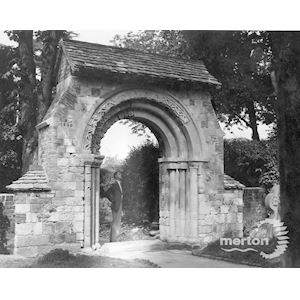
At the heart of Medieval Merton lay the Augustinian priory of St.Mary, founded in 1114 by Gilbert the Norman Sheriff of Surrey. In 1117 the original timber structure was abandoned in favour of a new 60 acre site ( now more familiar as Merton Abbey Mills, Merantun Way and a Sainsburys/M& S complex. ) This site in Colliers Wood was chosen as it provided water for drinking, washing and sanitation, plus wood for fuel and building material. Over the next 2 centuries an army of stonemasons, carpenters, plumbers and glass blowers constructed a vast priory complex. Surviving fragments of building material, displayed here, still show signs of the tools used during construction. The vast Priory church was similar in size to Westminster Abbey. There were cloisters for prayer, a scriptorium for producing illuminated manuscripts, dormitories, a refectorium or canteen and an infirmary where herbal medicines were used to treat a variety of ailments. There was also accommodation for visitors, including Royalty. One of the most powerful religious institutions in southern England, the priory was home to a community of Augustinian canons. Inspired by the teachings of St Augustine of Hippo, a Christian Bishop from what is now known as Algeria, they not only worshipped God but also ministered to the local community, providing basic education, medicines and alms for the poor. They were also supported by local residents who worked on priory land and farms in Mitcham and West Barnes. The administrative heart of the priory was the chapter house, the remains of which can be seen under Merantun Way. Here various documents were compiled, famously including the Statutes of Merton – the basis of English Common Law. The Priory was linked to many notable individuals – Thomas Becket ( later Archbishop of Canterbury ) was educated there, as was Walter de Merton, founder of Merton College, Oxford and Nicholas Brakespeare ( the first English pope. ) Both Eleanor, queen of Henry III and the infant Henry VI underwent coronation ceremonies within the Priory grounds. Many local noblemen also sought burial in the Priory church, in the hope of gaining access to heaven. In 1538 the Priory was closed and its wealth seized by the Crown as part of Henry VIII’s Dissolution of the Monasteries. Much of the fine stonework was removed and used to build the King’s new palace at Nonsuch, whilst the remaining structures fell into disrepair. During the 1980s major excavation by the Museum of London revealed more of the Priory’s history, including the contents of multiple burials. Today Merton Priory Trust is running the chapter house visitor centre to raise awareness of this important site.

Merton Heritage and Local Studies Centre
The Merton Heritage and Local Studies Centre tells the story of Merton and its people through a changing programme of exhibitions and events. This audio guide is part of a range of activities and support for local adult residents living with special needs, including autism, visual impairment and hearing loss. This project will help make Merton’s local heritage more accessible to visitors with a range of needs. Please refer to our website for opening hours.
- Merton Heritage Local Studies Centre
- London United Kingdom
- 020 8545 3239/4038
- libraries.merton.gov.uk/client/en_gb/