Housing in Merton
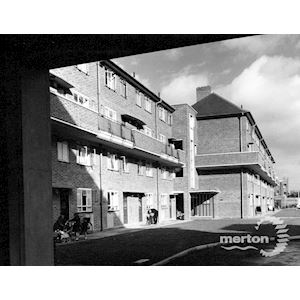
Housing in Merton has always been varied. The St Helier Estate was constructed on farm land previously used for agriculture, whilst in Mitcham, high rise estates such as Phipp’s Bridge replaced cottages and sub standard housing. After the Second World War, Nissen huts and prefab housing were constructed for Londoner’s who had lost their homes in the Blitz. Properties in Wimbledon mainly consisted of Victorian and Edwardian houses and villas. Older houses often had outside toilets and people washed in front of the fire using a tin bath. Even on the newly built St Helier Estate, some of the houses had bathrooms with no running water, whilst in other houses the bath was in a corner of the kitchen. Over the decades household interiors have ranged from Art Deco style in the 1930’s, to more practical Utility décor in the 1940’s due to wartime rationing. In peacetime it was often a case of, “out with the old and in with the new.” People wanted to leave the war behind them - have fitted kitchens with modern appliances and bright, cheerful décor with bubblegum colours. 1950’s interiors were influenced by the atomic age, with sputnik inspired wallpaper and furniture. Nodding dogs, pineapple ice buckets and flying ducks were the ornaments of the time. As television sets became more affordable, family life revolved more around the TV screen rather than the radio, although families still had fun playing board games such as Chinese Checkers. The Coronation of Queen Elizabeth II saw a dramatic rise in television sales and rentals. The 1960’s “Swinging London” era inspired psychedelic patterns for materials and wallpaper designs were bold, brown and very orange. Shag pile carpets, bean bags, lava lamps and pop art adorned the living rooms. By the 1970’s cheap travel enabled holidaymakers to bring back foreign inspired ornaments such as Moroccan rugs and lamps, donkeys, fans and flamenco dolls. Teak wood furniture was popular and later into the 70’s pine panelling and pine furniture was all the rage, as was wood chip wallpaper.

Merton Heritage and Local Studies Centre
The Merton Heritage and Local Studies Centre tells the story of Merton and its people through a changing programme of exhibitions and events. This audio guide is part of a range of activities and support for local adult residents living with special needs, including autism, visual impairment and hearing loss. This project will help make Merton’s local heritage more accessible to visitors with a range of needs. Please refer to our website for opening hours.
- Merton Heritage Local Studies Centre
- London United Kingdom
- 020 8545 3239/4038
- libraries.merton.gov.uk/client/en_gb/