52. Guild hall
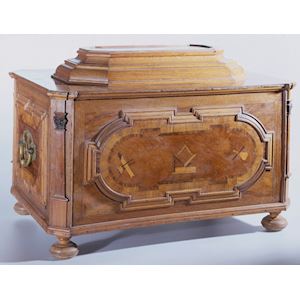
Welcome to the guild hall of the Märkisches Museum. Nowadays the term “guild” is not particularly well known. But a guild used to be an important association of craftsmen such as painters or carpenters, locksmiths or bakers. Guilds had great economic influence from the Middle Ages until the 19th century. They set fixed wages, controlled the competition and the quality of work, or helped craftsmen in distress. Here you can see a guild chest from a carpenter’s guild. It dates back to 1745 and is elaborately adorned with backrests, brass handles and spherical feet. On its side it features the tools of a carpenter: planer, compass and scales. This chest was used to store important documents or trophies like the ones you see on the table. It was opened only during guild meetings. This hall was designed by Ludwig Hoffmann as a memorial for Berlins’ craftsman. At the time it was built, the guilds no longer existed. Because with the introduction of the free right to carry on a trade in 1810, the guilds gradually lost their influence. Around that time many of their important objects were donated to the museum.

Märkisches Museum
Due to the current circumstances we invite you to take a digital tour through the permanent exhibition BerlinZEIT. The Stadtmuseum Berlin presents at Märkisches Museum a host of artefacts related to the culture and history of the city. A strong level of civic engagement had already led to the foundation of the Museum in 1874. From 1899 to 1908 architect Ludwig Hoffmann designed this first city museum in the world.
- Am Köllnischen Park 5
- Berlin Germany
- +49 30 24002162
- www.stadtmuseum.de/maerkisches-museum