38. Albert Einstein
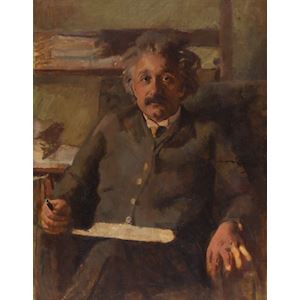
Berlin was an international hub for science at the turn of the 20th century. The city attracted many outstanding scientists with its unique intellectual climate and research opportunities. Amongst them were numerous Nobel Prize winners, including Albert Einstein. He was a member of the Prussian Academy of Sciences and the Director of the “Kaiser-Wilhelm-Institute for Physics”. Hitler’s rise to power in 1933 horrified Einstein. It happened during one of his trips to the United States. Einstein knew he could not return to Berlin, where the violence against dissenters increased. As a critical scholar and a Jew, Einstein saw no future in Hitler's Germany. He publicly spoke out against the Nazis. And renounced his German citizenship and his membership of the Academy of Sciences. Publicly he repeatedly declared his commitment for democracy: He only ever wanted to live in a country where all citizens were equal. He found his new home in the United States at Princeton University. He died there in 1955. Apart from Einstein many other scientists left Germany in 1933 and went into exile.

Märkisches Museum
Due to the current circumstances we invite you to take a digital tour through the permanent exhibition BerlinZEIT. The Stadtmuseum Berlin presents at Märkisches Museum a host of artefacts related to the culture and history of the city. A strong level of civic engagement had already led to the foundation of the Museum in 1874. From 1899 to 1908 architect Ludwig Hoffmann designed this first city museum in the world.
- Am Köllnischen Park 5
- Berlin Germany
- +49 30 24002162
- www.stadtmuseum.de/maerkisches-museum