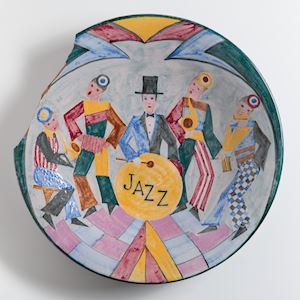
35. Jazz Bowl
The 1920s were a time of apparent stability in Berlin. The metropolis became a symbol for a new type of freedom. At least for those who could afford it. The city absorbed modern impulses, primarily from the US: amongst them Jazz. Jazz originated in the southern states of the USA around 1900. Improvisation was one of its key features. The popular dances Foxtrot or Charlston, captivated the audience with their jazzy rhythm. This Jazz plate depicts a scene from the Roaring Twenties. But in 1929 the Great Depression hit Berlin hard. More than half a million people lost their job. Poverty grew and radical parties gained support. Violence and street fights became commonplace. Many no longer believed that democratic parties could solve their problems. At the end of 1932, more than one million Berliners voted for the Nazis. In 1933 Hitler became Chancellor and the Nazi dictatorship began. The Nazis disliked modern music. They permitted only so-called "decent" Jazz. This distinction was vague. But on the radio, the Nazis prohibited any music of American jazz musicians with Jewish or Afro-American roots.
Märkisches Museum
Due to the current circumstances we invite you to take a digital tour through the permanent exhibition BerlinZEIT. The Stadtmuseum Berlin presents at Märkisches Museum a host of artefacts related to the culture and history of the city. A strong level of civic engagement had already led to the foundation of the Museum in 1874. From 1899 to 1908 architect Ludwig Hoffmann designed this first city museum in the world.
- Am Köllnischen Park 5
- Berlin Germany
- +49 30 24002162
- www.stadtmuseum.de/maerkisches-museum