29. Rudolf Virchow
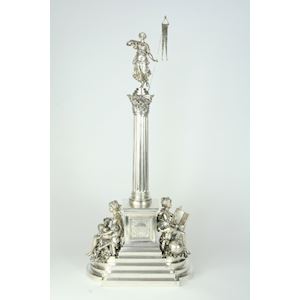
For me, politics is medicine on a grand scale. A doctor takes care of his patients. Politics must take care of the people. I've done my bit. I’m Rudolf Virchow. This pillar was a gift from the German Progress Party which I co-founded. It's a tribute for my merits. Can you see the figures with the globe and the skull? They stand for the subjects of Ethnology and Anthropology. I did research in both. But I studied medicine. Some call me the father of modern pathology because of my cell research. Why am I politically active? During my time in Upper Silesia I realized how social circumstances determine life: It was mostly the poor that died of typhoid fever. I wanted to change that. So, I marched for equality during the Revolution of 1848. That cost me my position at the Charité but I've achieved a lot since then. On my advice, Berlin built a modern sewage system, public hospitals, market halls and a central slaughterhouse. My aim was to improve the quality of life for everyone. Rudolf Virchow was also involved in founding this museum. The Virchow Hospital still bears his name today.
Märkisches Museum
Due to the current circumstances we invite you to take a digital tour through the permanent exhibition BerlinZEIT. The Stadtmuseum Berlin presents at Märkisches Museum a host of artefacts related to the culture and history of the city. A strong level of civic engagement had already led to the foundation of the Museum in 1874. From 1899 to 1908 architect Ludwig Hoffmann designed this first city museum in the world.
- Am Köllnischen Park 5
- Berlin Germany
- +49 30 24002162
- www.stadtmuseum.de/maerkisches-museum