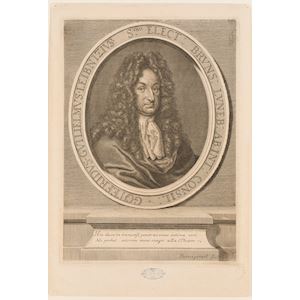
21. Gottfried Wilhelm Leibniz
Unlike Paris or London, Berlin was no famous place for science before 1700. This changed with the foundation of the Prussian Academy of Sciences. It was established at the same time as the Baroque Palace was built. Academy and palace both highlighted the new significance of Berlin as a royal residence. The Academy was shaped by its first president: Gottfried Wilhelm Leibniz. His contributions to science put Berlin on the map. Who was that man? Today, Leibniz is considered one of the great polymaths. He was a philosopher, mathematician and lawyer. He wrote articles on theology, history or mining. His calculator invention made him an honorary member of the Royal Society. Gottfried Wilhelm Leibniz shaped the Prussian Academy of Sciences after the European model. Here scholars could meet and discuss their work. The aim was to make science applicable for practical use. The French philosopher Diderot said about Leibniz: “He alone brought Germany as much fame as Plato, Aristotle and Archimedes together brought Greece.”

Märkisches Museum
Due to the current circumstances we invite you to take a digital tour through the permanent exhibition BerlinZEIT. The Stadtmuseum Berlin presents at Märkisches Museum a host of artefacts related to the culture and history of the city. A strong level of civic engagement had already led to the foundation of the Museum in 1874. From 1899 to 1908 architect Ludwig Hoffmann designed this first city museum in the world.
- Am Köllnischen Park 5
- Berlin Germany
- +49 30 24002162
- www.stadtmuseum.de/maerkisches-museum